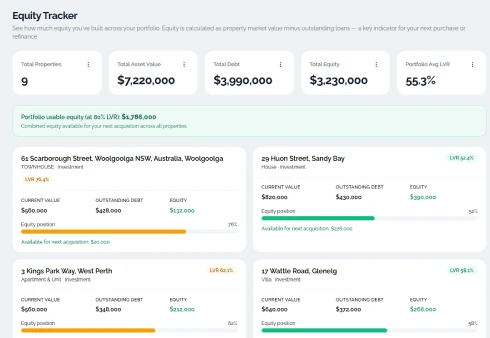
Most investors know the LVR of each loan. Fewer know their portfolio LVR, the total debt across all properties compared with their total value. It is one of the clearest measures of your overall position and borrowing headroom.
Portfolio LVR = total loan balances ÷ total property values × 100
Total value: $3,200,000. Total debt: $2,020,000. Total equity: $1,180,000.
Portfolio LVR = $2,020,000 ÷ $3,200,000 × 100 = 63.1%.
This example is illustrative only.
A portfolio can have a comfortable overall LVR while one property sits above 80%. Lenders look at each security property, so it is worth tracking both the individual and the portfolio figures.
Your LVR changes as you pay down loans and as values move. Reviewing it regularly helps you plan your next purchase, refinance or renovation.
Property Folio AI adds up every property and loan for you and shows your total equity and portfolio LVR on one dashboard.
Start your 30-day free trialIt depends on your goals and risk tolerance. Many investors aim to keep it well below 80% to keep a buffer for market changes.
No. LVR usually refers to one loan and property. Portfolio LVR combines all your loans and properties.
By paying down debt, adding offset savings, or as property values grow over time.
This article is general information only and is not financial, tax or legal advice. Consider speaking with a licensed professional about your circumstances.